
 |



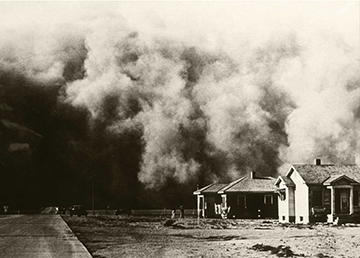
“Let me tell ya how it was. I don’t care who describes that to you, nobody can tell it any worse than what it was. And no one exaggerates that; there is no way for it to be exaggerated. It was that bad.” — Don Wells, Boise City, Oklahoma |
|
It was the worst man-made ecological disaster in American history—in which the heedless actions of thousands of individual farmers, encouraged by their government and influenced by global markets, resulted in a collective tragedy that nearly swept away the breadbasket of the nation.
It was a decade-long natural catastrophe of Biblical proportions—encompassing 100 million acres in Oklahoma, Texas, Kansas, Colorado and New Mexico—when the skies withheld their rains, when plagues of grasshoppers descended on parched fields, when bewildered families huddled in dark rooms while angry winds shook their homes and pillars of dust choked out the mid-day sun.
And it was an epic of human pain and suffering—a crucible of dust, drought and Depression, when normally self-reliant fathers found themselves unable to provide for their families; when even the most vigilant mothers were unable to stop the dirt that invaded their houses from killing their children by “dust pneumonia;” when thousands of desperate Americans were torn from their homes and forced on the road in an exodus unlike anything the United States has ever seen.
But the story of the Dust Bowl is also the story of heroic perseverance—of a resilient people who, against all odds, somehow managed to endure one unimaginable hardship after another to hold onto their lives, their land and the ones they loved.
And it is both a study of the roles and limits of government, as well as a morality tale about our relationship to the land that sustains us—a lesson we ignore at our peril.
The Dust Bowl, a two-part, four-hour documentary from Ken Burns, chronicles this critical moment in American history in all its complexities and profound human drama. It is part oral history, using compelling interviews of 26 survivors of those hard times—what will probably be the last recorded testimony of the generation that lived through the Dust Bowl. Filled with seldom seen movie footage, previously unpublished photographs, the songs of Woody Guthrie, and the observations of two remarkable women who left behind eloquent written accounts, the film is also a historical accounting of what happened and why during the 1930s on the southern Plains.
Directed by
KEN BURNS
Written by
DAYTON DUNCAN
Produced by
DAYTON DUNCAN
KEN BURNS
JULIE DUNFEY
Edited by
CRAIG MELLISH
RYAN GIFFORD
Associate Producers
AILEEN SILVERSTONE
SUSAN SHUMAKER
Cinematography
BUDDY SQUIRES
STEPHEN McCARTHY
Narrated by
PETER COYOTE
Voice of Caroline Henderson
CAROLYN McCORMICK
Other Voices
PATRICIA CLARKSON
KEVIN CONWAY
AMY MADIGAN
Assistant Editors
RICHARD RUBIN
MEAGAN FRAPPIEA
Technical Director
DAVE MAST
Apprentice Editor
KATY HAAS
Program Advisors
PAUL BARNES
SARAH BOTSTEIN
TIM CLARK
TIMOTHY EGAN
PAULINE HODGES
R. DOUGLAS HURT
WILLIAM E. LEUCHTENBURG
DAVID McMAHON
LYNN NOVICK
PAMELA RINEY-KEHRBERG
GEOFFREY C. WARD
DONALD WORSTER
Executive Producer
KEN BURNS
Funding Provided by
Bank of America
Public Broadcasting Service
Corporation for Public Broadcasting
National Endowment for the Humanities
The Arthur Vining Davis Foundations
Rockefeller Foundation
Wallace Genetic Foundation
The Better Angels Society, including
the Dana A. Hamel Family Charitable Trust
and Robert and Beverly Grappone